How Much Protein Do You Actually Need in a Day? A Straight Breakdown in Grams per Kilo
If you've Googled this before, you've probably landed on five different numbers from five different sources. So let's actually sort through the research and give you a straight answer, broken down by what you actually do day to day.
The RDA is a floor, not a target
The official Recommended Dietary Allowance (RDA) for protein is 0.8 grams per kilogram you weigh, per day.(1) For a 70kg person, that's about 56g a day. Here's the catch nobody tells you: the RDA was designed as the bare minimum so your body doesn't fall short of protein, not a target amount for someone who exercises or lifts weights regularly.(1) If you're only hitting the RDA, you're covering your basic needs and nothing more.
By what you do: what the research actually recommends
Everyday life: 1.0–1.2g per kg you weigh per day, for people who are moderately active but not training seriously for a sport or competition.(2)
If you lift or train regularly: The American College of Sports Medicine, the Academy of Nutrition and Dietetics, and Dietitians of Canada all converge on 1.2–2.0g per kg per day for people who train.(3) The International Society of Sports Nutrition backs a similar range of 1.4–2.0g per kg.(3)
When you're eating fewer calories than you use: This is where protein needs actually go up, not down. Research supports 1.6–2.2g per kg per day during this time, and some evidence suggests pushing towards 2.0–2.6g per kg when the calorie gap is fairly large.(4)
Older adults (65+): Researchers have found that as we get older, the body becomes less responsive to the protein we eat – a phenomenon they call "anabolic resistance."(2) For this reason, around 1.2g per kg per day is generally recommended for older adults, which is meaningfully above the standard RDA.
A quick real-world example
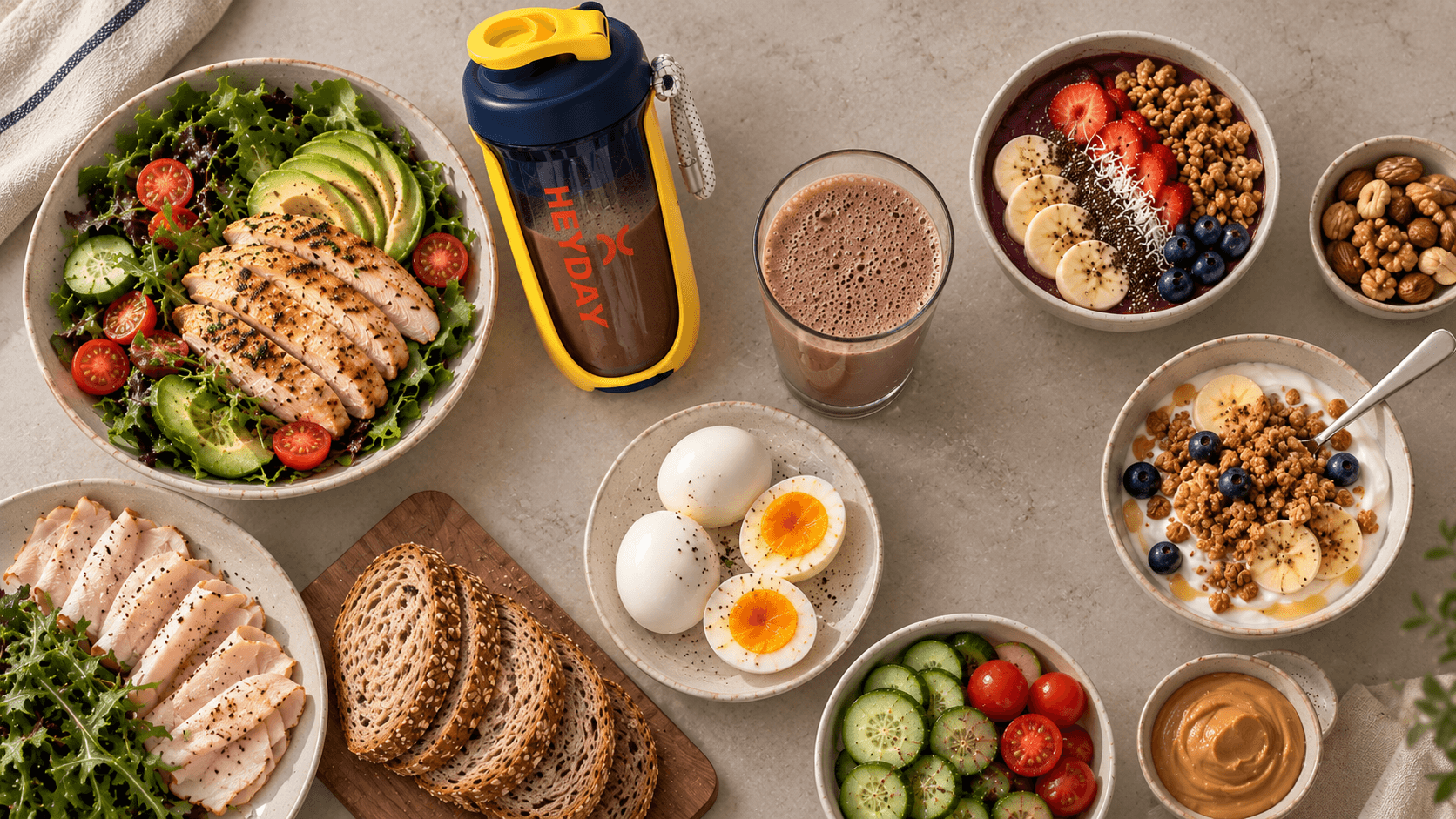
Let's say you're 70kg and you lift weights regularly. At 1.6g/kg, that's 112g of protein a day. Spread across 4 meals, that's about 28g per meal – roughly one solid protein source plus a shake, not some enormous chicken-breast marathon.
The part people get wrong
More isn't always better past a certain point. Research suggests intakes above roughly 2g per kg per day don't provide meaningfully more benefit for most people, and consistently very high intakes (1.07–1.6g/kg was classified as "high protein" in at least one study) haven't shown extra benefit over well-dosed moderate-high intakes.(4) Protein distribution across the day also matters more than most people realise – research suggests spreading 20–40g per meal across 4–5 meals rather than cramming it all into one giant dinner.(5)
So what does this mean for your shaker?
A shake is one of the easiest ways to close the gap between the protein you're actually eating and the target you've set, especially on busy days when hitting 100g+ from whole food alone is a lot of cooking and chewing. Figure out your target from the ranges above, track your food for a few days to see where you're actually landing, and use a shake to fill whatever's left over.
(1) RDA of 0.8g/kg established via nitrogen balance studies through the Dietary Reference Intakes process, National Academies of Sciences.
(2) Phillips SM, Chevalier S, Leidy HJ. "Protein 'requirements' beyond the RDA: implications for optimizing health." Appl Physiol Nutr Metab. 2016.
(3) American College of Sports Medicine, Academy of Nutrition and Dietetics, Dietitians of Canada joint position statement; International Society of Sports Nutrition position stand.
(4) Transparent Labs protein intake breakdown citing ISSN-aligned research ranges; Rose-Francis, cited in Healthline (2025), on high-protein intake classification.
(5) Research on protein distribution across meals, cited via ATHLEAN-X protein calculator sourcing.